
Greater Boston & Eastern Massachusetts
Chimney Rebuilds & Restoration
When repointing can no longer save a chimney, we take it down to sound masonry and build it back correctly - partial roofline-up rebuilds, full reconstructions, and historic restorations with matched brick.
In the Boston market, partial rebuilds from the roofline up typically run $2,500–$7,500 and full ground-up rebuilds generally range from $8,000 to $20,000 or more, driven by height, brick selection, staging, and lining - every project is priced from a detailed written scope.
Homeowners rarely search for "chimney rebuild cost Boston" out of idle curiosity. Usually something prompted it: a damp smell after a rainstorm, a chunk of mortar on the roof, a home inspector's note, or a fireplace that suddenly will not behave. Whatever brought you here, you are asking the right question at the right time, because chimney problems share one trait — they get more expensive the longer they sit. In this article, the team at Upside Down Chimney Sweeps in Melrose, Massachusetts walks through what is actually going on, how professionals diagnose it, what the fix generally involves, and what drives the price. No scare tactics and no fluff, just the working knowledge our sweeps use every day in Greater Boston homes. If you would rather talk it through with a person, call us at (781) 653-5644.
Ask any experienced sweep to name the real enemy of chimneys and the answer will not be fire — it will be water. Masonry is porous. Rain and snowmelt soak into brick and mortar, and every time temperatures cross freezing, that trapped water expands roughly nine percent, prying material apart from the inside. In a Massachusetts winter, a single week can deliver several freeze-thaw cycles. The chimney's defenses against this — the crown on top, the cap over the flue, the flashing where brick meets roof, and breathable water repellents on the masonry face — all wear out on their own schedules. When any one fails, water gets in, and nearly every expensive chimney problem we see traces back to that moment. Whatever symptom brought you here, water is the first suspect worth ruling out.
Homeowners insurance shapes chimney problems in ways people rarely anticipate. Most policies distinguish sharply between sudden, accidental events — a chimney fire, storm damage from a falling limb — and gradual deterioration, which carriers classify as deferred maintenance and typically decline to cover. That distinction puts the cost of neglect squarely on the homeowner. It also makes documentation valuable: a record of annual inspections per NFPA 211 demonstrates that a failure was genuinely sudden rather than years in the making, which can matter enormously during a claim. And if a chimney-related incident does occur, the insurer's first question is usually when the system was last inspected. Handling the problem behind your search promptly, and keeping the paperwork, protects both your house and your position if you ever need to file.
Chimney Rebuilds & Restoration Across Greater Boston
Upside Down Chimney Sweeps rebuilds and restores chimneys across Greater Boston and Greater Boston from our home base at 20 Sewall Street in Melrose. We handle the full arc of the project: the inspection and documentation, the permit where your building department requires one, safe demolition with debris contained and hauled, the rebuild itself, and the crown, flashing, liner, and cap that determine how long the new masonry lasts. We will also tell you plainly when you do not need us - some chimneys marketed for rebuilds by storm-chasing outfits need only honest repointing. For a straight answer and a documented assessment, call (781) 653-5644.
Rebuilding in Eastern Massachusetts carries obligations that generic masonry work does not. The housing stock in Greater Boston includes Victorians, colonials, and triple-deckers whose chimneys are architectural features - corbelled tops, decorative courses, brick that has not been manufactured in eighty years. A rebuild that ignores this reads as a wound on the house. We match brick by dimension, color range, and texture, sourcing reclaimed material when the original run is extinct, and we photograph and replicate corbels and detail courses before demolition. Just as important is what goes inside: many old flues were never lined at all, and a rebuild is the one moment when installing a UL-listed stainless liner, correctly sized to your appliance, costs the least and disrupts nothing.
Stand across the street and sight along the top of your chimney against the sky. Straight lines and crisp corners mean the stack is holding. A lean, a visible curve, a ragged silhouette, or daylight through the upper courses means the masonry above your roof has begun to let go. Every chimney reaches a point where the arithmetic flips - where the joints have eroded so far, and the brick has spalled so deeply, that repointing would mean gluing together material with nothing left to give. At that point the honest recommendation is a rebuild: take the chimney down to sound masonry and construct it again, correctly, with a modern crown and a properly sized flue. It sounds drastic. In practice, it is how a hundred-year-old chimney earns its next hundred years.
What the Service Includes
1Partial Rebuilds from the Roofline Up
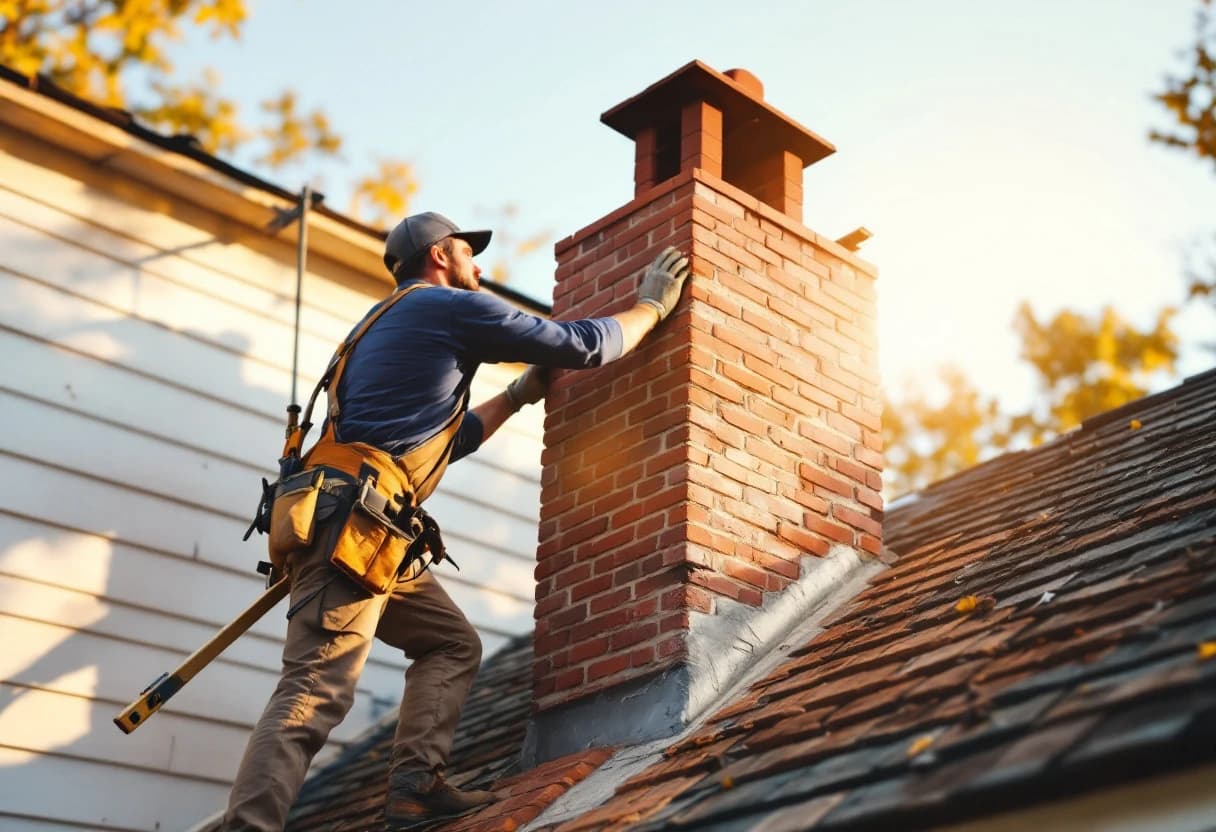
The workhorse of chimney reconstruction. We dismantle the deteriorated stack down to sound, well-bonded masonry - typically at or just below the roofline - then relay it course by course, plumb and square, with mortar suited to the brick. The rebuilt section gets everything the original lacked: a sloped, overhanging cast crown with a bond break at the flue, new counter-stepped flashing, and a stainless cap. Because the failure zone above the roof is rebuilt entirely rather than patched, this is usually the most cost-effective permanent fix for a badly weathered chimney.
2Full Chimney Rebuilds
When movement, crushed flue tiles, interior mortar washout, or foundation settlement compromise the chimney through the structure, we rebuild from the base or the smoke shelf up. This is a staged, engineered project: protection inside the home, sequenced demolition through the roof and floor penetrations, and reconstruction with a new code-compliant flue path from appliance connection to termination. Full rebuilds are also the opportunity to correct old sins permanently - undersized flues, missing wall clearances, and combustible framing set tight against the masonry, all conditions NFPA 211 exists to address.
3Historic Restoration and Brick Matching
On older homes in Greater Boston, the chimney is part of the architecture, and we rebuild it that way. Before demolition we document corbelled tops, decorative banding, and wash courses with photographs and measurements, then replicate them in the reconstruction. Brick is matched by size, color range, and surface texture - reclaimed brick where the original is no longer made - and mortar is blended to period-appropriate softness and sand color. The goal is a chimney a preservation-minded neighbor cannot pick out as new, with a century of modern service life hidden inside it.
4Flue Lining During Rebuild
A rebuild with the stack open is the cheapest moment your chimney will ever have to gain a proper liner, and we rarely rebuild without one. We install UL-listed stainless steel liners sized to the connected appliance - wood stove, fireplace, oil burner, or gas - insulated where the listing and conditions require it. Correct sizing matters as much as the metal: an oversized flue cools exhaust, kills draft, and breeds condensation and creosote. A continuous, listed liner restores the sealed path that keeps combustion gases off your framing and out of your rooms.
5Crown, Flashing, Cricket, and Cap Integration
The rebuilt masonry survives only as long as its water-shedding system, so we build that system in rather than bolting it on. The crown is cast concrete, sloped and overhanging with a drip kerf, isolated from the flue by a bond break. Flashing is two-part: step flashing woven into the shingles, counter-flashing let into the mortar joints above. On wide chimneys on the downslope side of the roof, we add a cricket to split water and sliding snow around the stack. A stainless multi-flue or single-flue cap finishes the top.
6Structural Assessment and Leaning Chimney Correction
A leaning stack is a falling hazard over your roof, your walkway, and your neighbor's driveway, and it demands diagnosis before reconstruction. We determine whether the lean comes from one-sided mortar erosion above the roof - the weather side always erodes faster - or from movement lower down, and we inspect footings and shoulder masonry before proposing scope. Where the cause is above the roofline, a partial rebuild solves it outright. Where settlement is involved, we coordinate the structural remedy first, so the new chimney is not built on the old problem.
How We Diagnose and Fix It
A thorough exterior diagnosis works from the top down, because that is how water attacks. The sweep starts at the crown — the concrete slab capping the chimney — checking for cracks, spalls, and improper construction like thin mortar-wash crowns that were never built to last. Next comes the cap and the condition of the flue tiles, then down the stack: mortar joint condition, spalled or shaling brick faces, staining patterns that map water paths, and finally the flashing where the chimney penetrates the roof, one of the most common leak points on any house. Each defect tells a story about sequence — which failure came first and what it caused next. That ordering matters, because repairing a downstream symptom while leaving the upstream cause intact is how homeowners end up paying for the same problem twice.
How a job ends matters as much as how it begins. Before final payment on significant chimney work, you should see evidence: after photos from the roof, camera footage for any interior flue work, and a walkthrough of what was done against the written scope. Materials should be identified specifically — the mortar type, the liner alloy and insulation, the sealant product — because those details determine lifespan and warranty. Ask what the warranty covers and get it in writing; established manufacturers back stainless liners and masonry water repellents with meaningful terms when installed correctly. Finally, the paperwork joins your home's records, where it pays dividends at sale time and with your insurer. Work like chimney rebuild is invisible from the curb when done well, which is exactly why the documentation has to do the showing.
Warning Signs to Watch For
- The chimney visibly leans, curves, or no longer lines up plumb when sighted against the sky.
- Whole bricks are loose, missing, or have fallen onto the roof or into the yard.
- Mortar joints in the upper courses have eroded so deeply that daylight shows through the stack.
- Previous repointing attempts keep failing because there is no sound mortar left to bond to.
- The masonry between roofline and crown looks ragged, stepped, or shorter than it used to be.
- Chunks of brick or clay flue tile keep appearing in the firebox or on the smoke shelf.
- Deep spalling has eaten past brick faces into the body of the wall across large areas.
- Diagonal or stair-step cracks run through the chimney where it passes the roof or shoulders.
- A home or insurance inspector has flagged the chimney as unsound or recommended it not be used.
- Water infiltration around the chimney persists even after crown, flashing, and joint repairs.
Why This Matters in New England
The Greater Boston real-estate market has quietly become a major driver of chimney work. Competitive sales once pushed buyers to waive inspections; the bills from that era are still arriving, as new owners discover what a fireplace-lit listing photo did not disclose. The correction is visible now: buyers' agents increasingly recommend a dedicated Level 2 chimney inspection during the contingency window, and attorneys and insurers ask better questions than they used to. For sellers, a documented chimney history has become a modest but real asset in a market where buyers are wary. Whether the property is a Cambridge condo with a shared stack or a single-family in the suburbs, the transaction is where deferred chimney maintenance finally gets priced. Our advice is simple: be the party who brought documentation to the table.
A word about who is writing this. Upside Down Chimney Sweeps is a Melrose-based company, not a national franchise or a lead-generation site reselling your phone number to whoever pays. The people who answer (781) 653-5644 are the people who dispatch the trucks. We built this guide because most of what ranks online for chimney questions is written far from New England, by people who have never dealt with a February ice dam or a hundred-year-old unlined flue, and Massachusetts homeowners deserve advice calibrated to the houses they actually live in. Everything in this article reflects how we actually work: inspect first, show evidence, put the scope in writing, and let the homeowner decide. If that approach suits you, we are easy to reach and happy to take a look at your chimney.
Nor'easters give chimneys in Greater Boston a beating that ordinary storms never match. These coastal systems drive rain and snow horizontally for hours at a time, forcing water against the sides of a chimney rather than politely down onto its cap. Wind-driven rain exploits every weakness: hairline cracks in the crown, thin spots in mortar joints, and lifted flashing at the roofline all become entry points under that kind of pressure. Homeowners often discover the aftermath weeks later, as a ceiling stain near the chimney or a damp, smoky odor in the firebox. After a hard nor'easter season, a careful inspection of the crown, flashing, and masonry is not paranoia; it is how storm damage gets caught while the fix is still small.
What It Typically Costs
Chimney repair pricing varies more than sweep pricing because chimneys fail in such different ways and places. The main drivers are extent, access, and materials. Repointing a few mortar joints is a different undertaking from rebuilding a chimney from the roofline up. Work high on a steep roof may require staging that a walk-up ranch never would. And in the older neighborhoods we serve, matching brick and mortar appropriately matters, both for appearance and because modern mortar that is harder than antique brick can actually accelerate damage to the original masonry. A written estimate after an actual inspection is the only number worth trusting, and it should itemize the work plainly enough to compare against any other bid.
Why Call Upside Down Chimney Sweeps
Homeowners often delay a chimney sweep because they picture soot drifting across the living room. A professional sweep should be, and with us is, a clean process from start to finish. We lay drop cloths from the door to the hearth, seal the fireplace opening, and run a HEPA-filtered vacuum the entire time the brushes are working, so fine ash goes into the machine instead of onto your furniture. Our technicians treat your home the way they would want their own treated: shoe covers on, tools organized, and the workspace left exactly as we found it, minus the creosote. When we finish, the evidence that we were there is a cleaner flue and a written report, not a mess.
Frequently Asked Questions
How do I know if my chimney needs a rebuild instead of repointing?
What does a chimney rebuild cost in the Boston area?
How long does a chimney rebuild take?
Can you match the original brick on an older home?
Will you install a liner during the rebuild?
Do I need a permit to rebuild a chimney in Massachusetts?
My chimney is leaning - is that an emergency?
How long will a rebuilt chimney last?
Get It Handled Today
You searched for chimney rebuild cost Boston, and the search can end here. Upside Down Chimney Sweeps handles this work for Greater Boston homeowners regularly, following NFPA 211 standards, documenting everything with photographs, and explaining findings without jargon or pressure. Call (781) 653-5644 to talk through your situation with someone who does this every day; a few minutes on the phone is usually enough to scope the visit and set a time. We show up when promised, protect your home while we work, and stand behind the results. There are certainly bigger companies and flashier websites out there, but for careful chimney work done close to home, we like our chances of earning your call and then keeping your business.
Need Chimney Rebuild?
Talk to a technician today — honest advice, clear pricing, and photo-documented work. Mon–Sat: 7:00 AM – 7:00 PM · Emergency service available
Mon–Sat: 7:00 AM – 7:00 PM · Emergency service available